


1. Conceding flaw. There are little chances that your insurance Claim Adjuster can do to guard you against the other driver's guarantor if you have effectively conceded shortcoming to the mischance. Regardless of the fact that you know whether it was your fault, let your accident coverage organization deal with the "fault" in the accident.
2. Not taking pictures. Attempt to take a picture of the accurate scene of the accident, obviously just in the event when it is safe to escape from the auto to do so. If you can't venture out of the auto, pull into the closest, safe stopping region and take pictures of the scene, and also each of the four sides of your auto, odometer and air packs (if the sacks conveyed). Doing this, can truly help you in accelerating the tactic and, as specified before, safeguard you if the case goes to a court.
3. Not calling the police. Indeed with small accidents, you ought to search out a cop to compose an authority police report. Some insurance claim agencies may feel that you may be concealing something deceitful if you report accident without an authority police report.
4. Not getting all important data. Other than getting the other driver's protection data, name, permit plate number, driver's permit number, you'll have to get other data too. A few points that you may be overlooking is the model of the auto, whether there are different travelers in the other auto, if there were kids in the auto, the reacting cop's name and insignia number, names and telephone numbers or any witnesses. This is data that needs to be rounded out when you make a protection claim for the accident.
5. Staying away from medical help. Despite the fact that you may feel fine promptly after the accident, the agony may uncover itself after a couple of days or even months after the fact. It may have appeared to be a light accident, yet the effect on your body may be extreme, for example, whip lash. Mention sure, say any harm to your protection claims agent with the goal that they can cover your doctor's visit expenses as well.
6. Not informing your insurance claim agency instantly. There are circumstances where the harm doesn't appear to be a great deal and the other driver implores you not to make an insurance claim so they can simply pay out of pocket. It is best if you tell them that you must report all accidents so that your transporter can take care of the expense of harms. Expenses may be higher than the other driver evaluated and they will be unable to blanket it out-of pocket.
Dodge these six oversights to accelerate your insurance claim process and to help in safeguarding your case. Pictures and authority police reports are the most ideal method for verifying that your actualities are correct.
Read More »
.jpg)
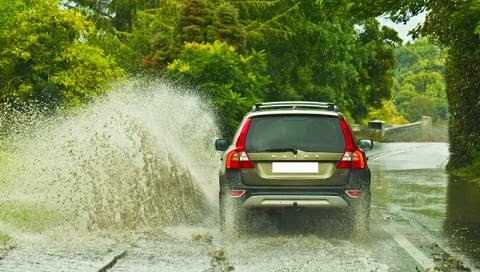
With winter now behind us, as the weather begins to finally get warmer, more drivers may be encouraged to hit the road. With the likely threat of wet weather in the months ahead, the condition of the roads in the early spring may begin to affect driving. There are many aspects to improving safe driving that go beyond just having the right auto insurance plan. By paying attention to the road, and being aware of difficult driving conditions, motorists can keep themselves and their families safe when driving during the wet season.
1. Navigating wet roadways can be tricky
This is true, especially as the weather begins to warm up. If it has not rained in a while, use caution when driving. This is because the roads will almost certainly become more slippery. Difficult driving conditions don't necessarily require significant rain, as a light sprinkle after a dry spell can make the road difficult to navigate because oils and other residue will begin to reach the surface, reducing a car's ability to grip the road.
2. Always drive cautiously, keeping an eye out for hazards
Driving slow will prevent slipping and sliding because of the wet surface, and a driver may not be able to stop if they are going too fast, or traveling too close to the car in front of them. Paying attention, and knowing what the road offers will help a driver get to and from their destination safely, especially when driving on slick roads when it is extremely important to make good decisions.
3. Traffic poses many dangers
In difficult conditions, keeping an eye on the flow of traffic is very important. While drivers are taught to keep a safe distance from other cars at all times, it is important to follow this rule even more closely on wet roads. Not allowing enough space can greatly increase the chances of a crash.
4. Concerns about other drivers
While one driver may be paying attention to the conditions, as well as the traffic, not everyone does this at all times. It is important for those behind the wheel to ensure they are aware of what is going on around them. Doing this can prevent accidents. Make sure to be aware that other cars can hydroplane or lose control at any time.
5. Puddles can cause accidents as well
Water that collects on the roadway can make a car hydroplane and force the driver to lose control. If driving around the puddle is not possible, reduce speed in order to better maintain vehicle control.
One more way to improve the feeling of being safe on the road is getting the proper auto insurance coverage. This will certainly help when an accident does occur.
Kellie M. Atkinson is an Insurance Agent for Dryfoos Agency which is located in Hazleton, Pennsylvania and specializes in Business Insurance, Surety Bonds and Worker's Comp.
Article Source: http://EzineArticles.com/7715270
Read More »

How should you choose between different types of commercial auto insurance? It all comes down to what your business does, and how your business does it.
As a business owner in any industry, protecting yourself and your business with the correct form of insurance is always crucially important. You must do everything that you can to guard against unforeseen circumstances before they occur, so they are unfortunate but never disastrous or ruinous for your company. Additionally, having the correct form of insurance may also be a requirement for your industry or profession.
When it comes to commercial auto insurance, how exactly can you find the right type of coverage? As always, this boils down to what your business does, including the goods you may be transporting or the services you may be providing, how your business does it, and what type of vehicle your business utilizes to fulfill that objective.
Along those lines, there are several broad classifications which will provide a good starting point. For example, one of the more common types of commercial auto insurance is owner operator insurance, sometimes abbreviated as OOIDA. This is specifically designed for individuals who are owner operators in the trucking industry, and provide for-hire transport services.
Many businesses utilize a regular car for simple purposes and end up needing commercial auto insurance in addition to personal auto coverage. For example, a realtor may drive clients from the office to various houses around town. Commercial auto insurance is needed here. Or perhaps you make deliveries of food or other goods. You need commercial auto here, too.
You might also be utilizing a business van for local deliveries of flowers, packages or newspapers, or anything else, or perhaps you give customers rides to and from your location in a van. Once again, you need commercial auto here too, although there are special policies specifically designed for company vans.
Another classification is commercial auto insurance for the construction and contracting industry. Whether you're the project manager and you simply are driving your car to the job-site, or you're hauling materials and equipment utilizing a van, truck, pickup, flatbed truck, or anything else, this is another specific type of coverage which is available.
There is also specialty business vehicle insurance. Specialty vehicles are those which don't fit easily into other broad categories, such as semi-trucks, 18 wheelers, pickup trucks or vans. Here, you'll find refrigerated trucks, log haulers, automobile haulers, tow trucks, wreckers, dump trucks, garbage trucks and waste haulers, and more. These all apply very specifically to certain types of vehicles, and in turn, certain types of businesses and services.
Of course, the list goes on from here. The most important thing you always have to do is find as specific a policy and coverage as possible. The good news is, there's an absolutely massive range of different coverage types and plans, so that's almost always fairly easily accomplished.
Article Source: http://EzineArticles.com/8684274
Read More »

With the emergence of the Internet and various online
opportunities, finding a stable source of home based income just got a lot less
complicated. In fact, more and more professionals these days prefer to practice
their honed skills at home. Instead of keeping a 9-to-5 job to pay the bills
and other household commodities, you can stay at home with your family and earn
just as much, or even more.
One of the most sought after stay at home jobs at
present is medical transcription. People with excellent typing skills and a
respectable medical knowledge can truly benefit from this kind of stay at home
job. However, landing this type of job may not be as easy as you would think,
especially since most companies hiring medical transcriptionists will require
experience, some will even ask for some sort of certification before they will
consider hiring you. A lot of people who want to get into this industry often
wonder how they can start a career in medical transcription. For most
individuals, the most appealing aspect of being a medical transcriptionist is
the prospect of working at home. But before we delve into the idea of you
finding a sustainable stay at home medical transcription work, you need to know
what the job really entails and what you can expect from it. A medical
transcriptionist's job basically centers on transcribing various reports, notes
and summaries dictated by medical practitioners through tape recording or
digital voice file. Just like a court stenographer, a medical transcriptionist
needs to be quick, accurate and skilled in typing. Only, medical transcription
does not require the use of stenography or shorthand writing since the data you
will typically be encoding involves medical histories, physical reports, clinic
and office notes, consultation summaries, operation and laboratory reports, and
even psychiatric evaluations. Basically, any medical report that needs encoding
falls into your job description. With the appropriate set of skills and
knowhow, you can make a decent career out of being a medical transcriptionist.
As a matter of fact, the medical transcription industry actually pays well,
especially with the demand for such personnel constantly growing. As a
professional medical transcriptionist, you have three basic options as to how
you want to work. An in-house transcriptionist who practices in hospitals,
clinics and other establishments that provide healthcare. A self-employed
medical transcriptionist who offers his or her services independently. A work
at home medical transcriptionist who takes on jobs on a contractual basis. You
can offer your services to various companies; whether locally, regionally, or
nationally based. Any of these job options can be quite lucrative, especially
for someone who has exceptional typing skills. Nowadays, a considerable number
of medical transcriptionists are able to work at home and still earn a
substantial amount of income that is enough to support the needs of their
families. If in the past a transcriber would still have to leave his home to
deliver his finished work to the office, with the availability of electronic
mail, everything can now be done at home.
Article Source: http://EzineArticles.com/7200644
Read More »
Subscribe to:
Posts (Atom)